How Accurate Are AI Calorie Counter Apps? The Honest Numbers
How accurate are AI calorie counter apps? Honest answer: very good on single, visible foods, noticeably weaker on mixed plates and hidden ingredients — and still better than the guessing most of us do without a tracker.
How accurate are AI calorie counter apps, really?
Independent evaluations of photo-based food recognition generally find that AI calorie counter apps identify single, clearly visible foods correctly around 85-95% of the time, and the calorie estimate for those foods usually lands close to the real number. For mixed meals — curries, casseroles, loaded plates — calorie estimates more typically fall within 20-35% of the truth, which works out to roughly 65-80% accuracy. The consistent finding across studies is that the weak spot is not recognizing what is on the plate; it is estimating how much of it there is, and accounting for what the camera cannot see.
Peer-reviewed reviews of image-based dietary assessment report average calorie errors ranging from nearly zero to almost 40% across studies, depending on the food, the photo quality and how ground truth was measured. That spread sounds alarming until you notice the pattern inside it: simple, separated foods sit at the accurate end, and complex or layered dishes sit at the messy end.
| What you scan | Typical result in published evaluations | The weak point |
|---|---|---|
| Single whole food (apple, banana, slice of pizza) | Strong — identification generally in the 85-95% range | Unusual portion sizes |
| Packaged food via barcode | Strongest — pulls actual label data | How many servings you actually ate |
| Simple plate, 2-3 separated items | Good — most items identified, calories usually within ~20% | Cooking method (fried vs. grilled) |
| Mixed or layered dishes (curry, burrito, casserole) | Weakest — errors of 20-35% or more are common | Hidden ingredients, depth of the dish |
| Oils, dressings, sauces | Often missed entirely | Invisible in a photo |
Ranges are broad because different studies test different foods and methods — but the ranking above shows up again and again.
Where AI calorie counting actually fails
Three failure modes cause most of the error, and knowing them is half the fix.
- Invisible calories. A tablespoon of olive oil is about 120 calories and leaves almost no visual trace. Dressings, butter used in cooking, sugar stirred into sauces — no camera-based system can see them. This is the single biggest reason restaurant meals get underestimated.
- Portions without a size reference. A photo flattens depth. A mound of rice could be 150 grams or 300, and studies consistently name portion estimation — not food identification — as the largest source of error in photo-based calorie counting.
- Look-alike foods. Whole milk and skim look identical. So do regular and diet soda, or fried and baked chicken. The AI has to guess, and it sometimes guesses the lower-calorie twin.
These limits apply to every photo-based tool, including general chatbots — we cover that comparison in using ChatGPT to count calories from a photo. Dedicated apps have one structural advantage: they are built for you to correct the result in a couple of taps, which chat interfaces make tedious.
Is 80% accuracy enough to lose weight?
For most people, yes — and this is the part accuracy debates usually miss. Suppose you are aiming for a 500-calorie daily deficit and your app misjudges a meal by 15%. You are still clearly in a deficit. Errors also partially cancel out over a week: some meals get overestimated, some underestimated, and the trend remains usable.
What actually sinks weight loss is not a 15% error on Tuesday's lunch. It is the meals that never get logged at all, and the slow drift of untracked snacks and oils. Your scale is the final feedback loop anyway — if your weight trend does not match your logged deficit after a few weeks, you adjust your targets, not your ambitions.
How Foodify handles the hard cases
Foodify is built around the assumption that no photo estimate should be final. Every scan produces an editable result — you see the detected foods, portions, calories and macros before anything is saved, so a missed dressing or an oversized rice estimate is a five-second fix rather than a silent error in your log.
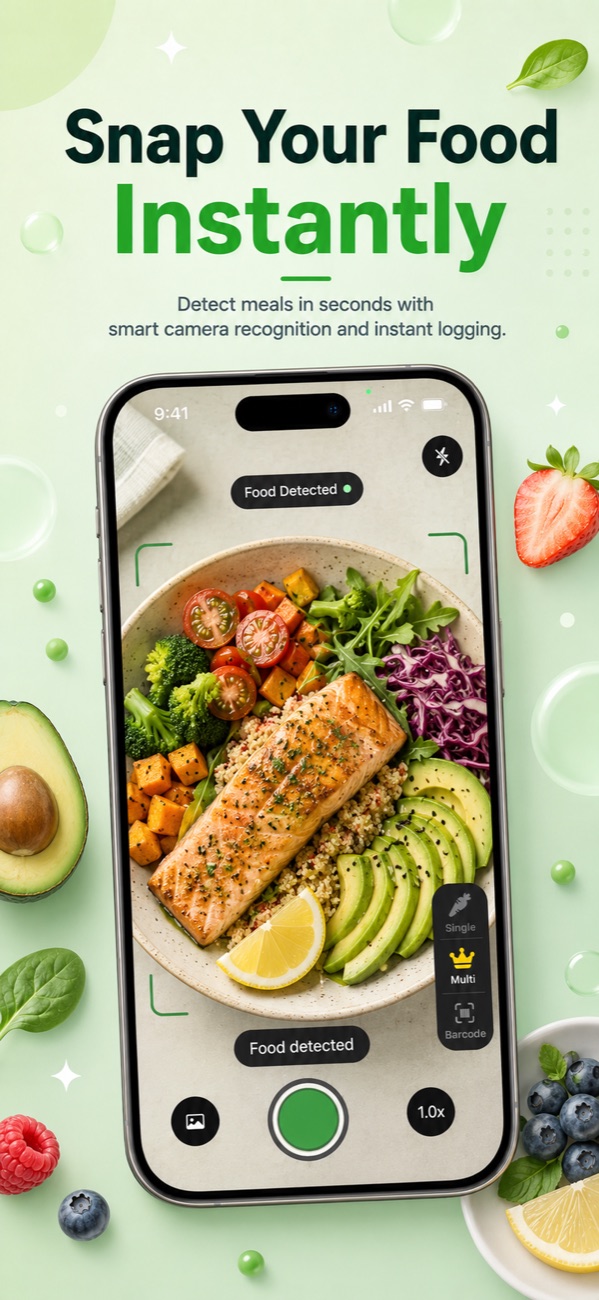
For crowded plates, Foodify runs multi-food detection, identifying each item on the plate separately with its own portion estimate — the failure mode where single-guess tools struggle most. And for packaged foods, the built-in barcode scanner sidesteps estimation entirely by using label data, which is the accuracy ceiling for any tracker. If you want the full walkthrough of photo logging, see our guide to counting calories from a picture, or compare tools in our roundup of the best AI calorie counter apps.
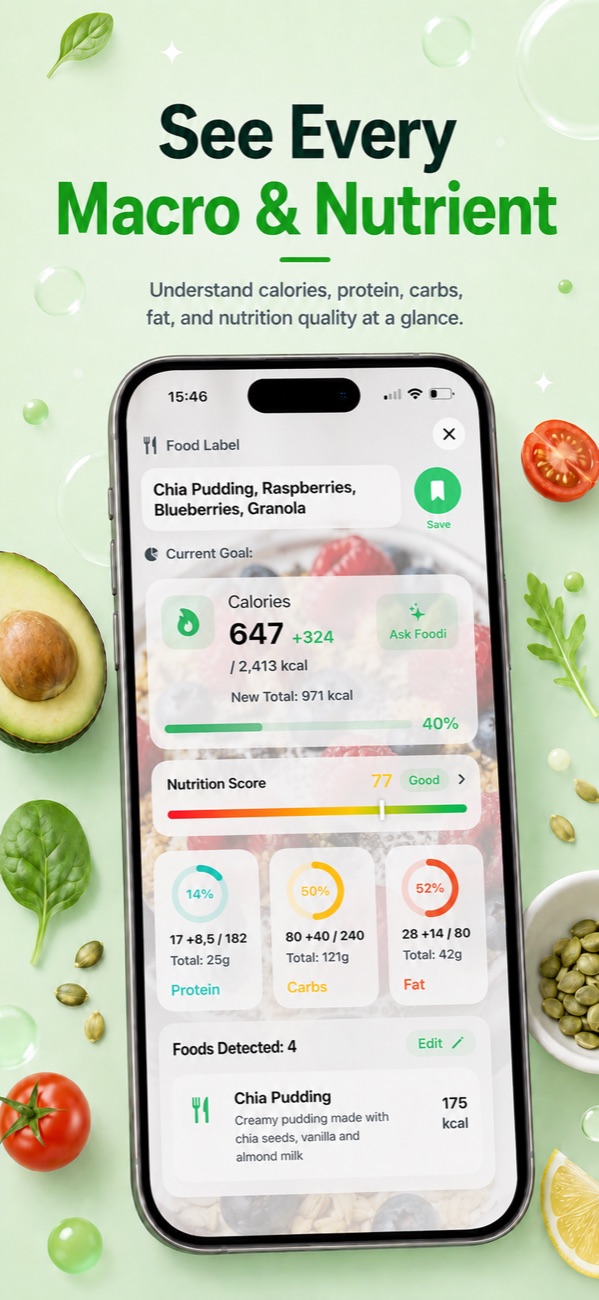
Foodify is free to download on iPhone with daily limits on AI features; Foodify Pro extends AI scans and adds meal plans, the Foodi AI coach and weekly insights, with a 3-day free trial.
How to get the most accurate scans
- Shoot from about 45 degrees, with the whole plate in frame and decent light. Straight-down shots hide depth; extreme side angles hide items behind each other.
- Keep a size reference in frame. A fork, your hand, or a standard dinner plate gives the model scale to work with.
- Separate foods when you can. Three visible items beat one indistinct pile.
- Add what the camera can't see. Cooked in oil? Dressing on the salad? Edit the result before saving — this is where most of the remaining error lives.
- Use the barcode for anything packaged. Label data always beats a visual estimate.
- Spot-check your regulars once. Weigh or check the label on two or three meals you eat often. You will quickly learn where your app runs high or low — especially useful for restaurant meals, where hidden oils do the most damage.
The comparison that actually matters: AI vs. guessing
Critics of AI calorie counter accuracy usually compare apps against a food scale. But the realistic alternative for most people is no tracking at all — and human self-estimation is far worse than any app. Doubly labeled water studies (the gold standard for measuring true energy expenditure) consistently find that people underreport what they eat: typically by 10-20% with food diaries, 20-30% with questionnaires, and far more in some groups. A well-known New England Journal of Medicine study from the early 1990s found that dieters who believed they "couldn't lose weight" were underestimating their intake by roughly 47% on average.
Against that baseline, an AI estimate within 20-35% on your hardest meals — and much closer on simple ones — is not a downgrade. It is a large upgrade over the default human setting, delivered with near-zero effort.
FAQ
Can AI calorie counters detect cooking oil and dressings?
No — oil absorbed into food and dressings mixed into a salad leave little or no visual signal, so photo-based systems routinely miss them. The reliable fix is editing the result: add a tablespoon of oil or dressing manually before saving. Apps that make edits fast, like Foodify's editable scan results, turn this from a flaw into a quick habit.
Is scanning food more accurate than typing it in manually?
Per entry, careful manual logging with a food scale is more precise. In practice, most people abandon weighing and searching within weeks, and unlogged meals are 100% inaccurate. Photo scanning trades a little per-meal precision for far better consistency — which is what determines results over months.
How accurate is portion size estimation from a photo?
It is the weakest link. Studies of image-based dietary assessment repeatedly identify portion estimation as the largest error source, with misses of 20-40% possible on amorphous foods like rice, pasta or mashed potatoes. Including a size reference in the photo and adjusting the portion when a guess looks off closes most of that gap.
Do AI calorie counters get more accurate over time?
The underlying recognition models keep improving year over year, but your personal accuracy improves faster than the technology does: after a week or two you learn which of your regular meals scan cleanly and which need a quick edit, and saved corrected meals mean your most frequent foods are logged exactly right every time after.
See what your plate really adds up to
Scan a meal with Foodify, check the numbers, and edit anything the camera can't see — free to download on iPhone.

Free to download · AI photo food scanning · iPhone